
The Fulnecky Zero

Happy 2026 everyone, I thought I’d start with writing about something that is right at the intersection of rhetoric, pedagogy, and society: The 2025 controversy about Samantha Fulnecky getting a zero on an essay she wrote about God, transgender people, and some other nonsense. What a terrible paper! Is this really college?
Was the paper about gender? Was it about her beliefs? Her interpretation of the Bible? It’s really unclear what the paper was about because it is unclear, from a rhetorical perspective, what the paper was meant to be. This is not to say that the instructor should have been fired or placed on leave – that seems rather extreme unless the context you read the controversy is one of an instructor telling a student what to think and what to believe without any context to it whatsoever.
This controversy is really perfect in a lot of ways because it represents what sort of discourse emerges in a society that has rejected the rhetorical and all it stands for – situational approaches, mind-changing, audience considerations, revision of belief – all of that goes out the window when you reject rhetoric in favor of the set of virtues we’ve decided to embrace in the United States now: commitment to a belief no matter what, speaking your truth no matter who is listening, vociferously defending your ideas against all questions, rejecting opposite opinions because you have “free speech,” ad nauseum. These discursive commitments are seen as strength, truth, and power versus a set of commitments rhetoric offers which are weak compromises and wishy-washy. The result is a society that is malnourished in terms of discourse. All the essential vitamins of free expression have been bleached out through the process of making a direct and simple set of claims you either reject or accept. Considering this modality of discourse to be our only means of argument and engagement should make it less of a surprise that we have a President simultaneously committed to uncomplicated, direct, aggressive policies without moderation and eating McDonald’s. Processed life!
Back to Fulnecky and the University of Oklahoma. From the rhetorical perspective there’s a lot of blame to go around for the situation. From the university perspective, I am at a loss why OU didn’t give their instructor due process. The only thing I can think of is my own experience working with administrators in my career as a professor – they are, without exception, the most cowardly group of people you will ever meet. I’m certain that fear from the national attention the story was getting had them just hoping to get rid of the issue by firing everyone involved and never speaking about it again. Administrators live by fear because they only have one goal – keep their job by keeping the university stable. And by stable, they mean stagnant. Innovation never comes from administration, rarely from faculty, most of the time from students.
Fulnecky could be the source of innovation, perhaps in the idea that assignments that ask for a rhetorical response actually consider what they are asking the student to do before they assign it. Here are the assignment instructions, courtesy of OU’s Turning Point organization’s Twitter account:
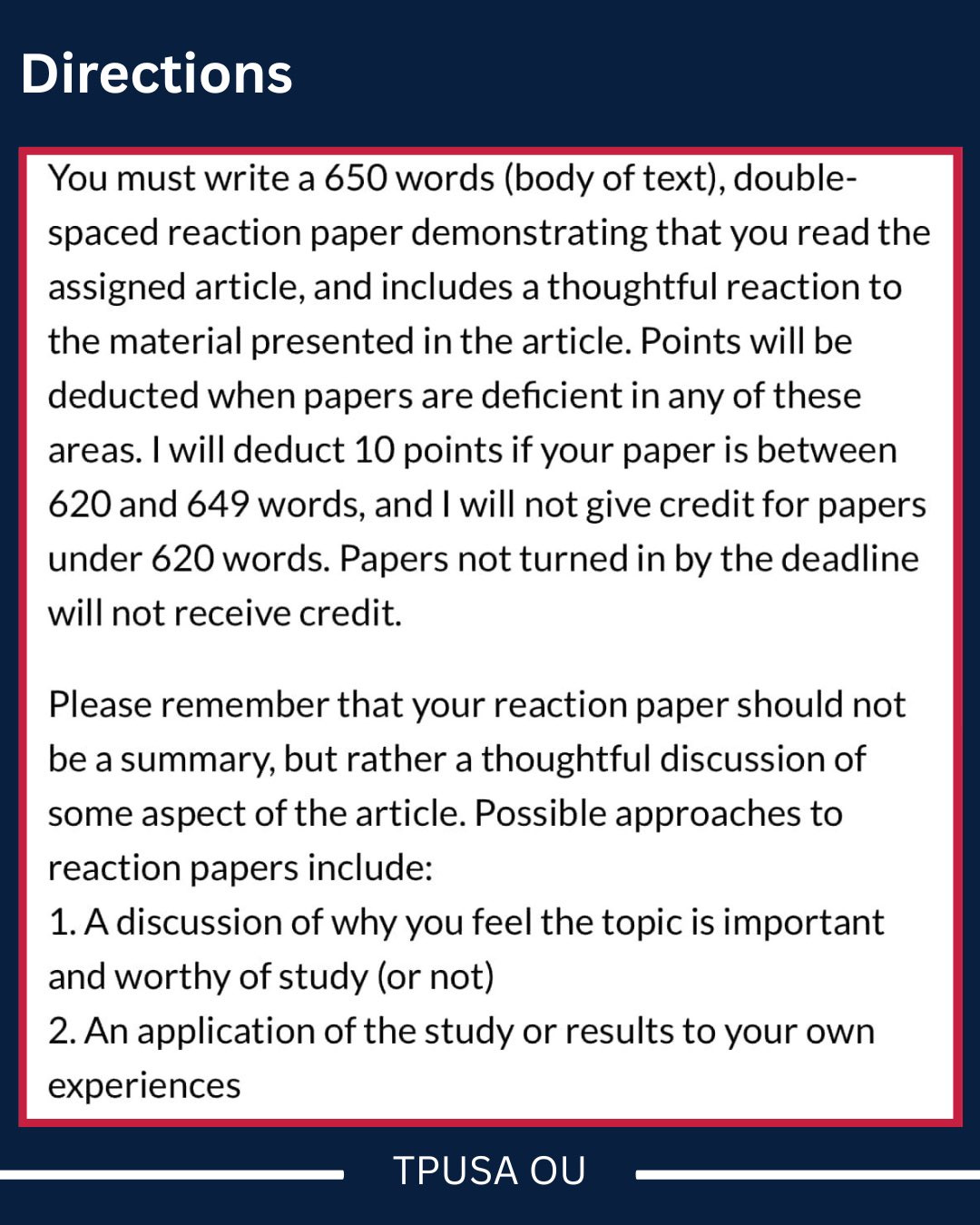
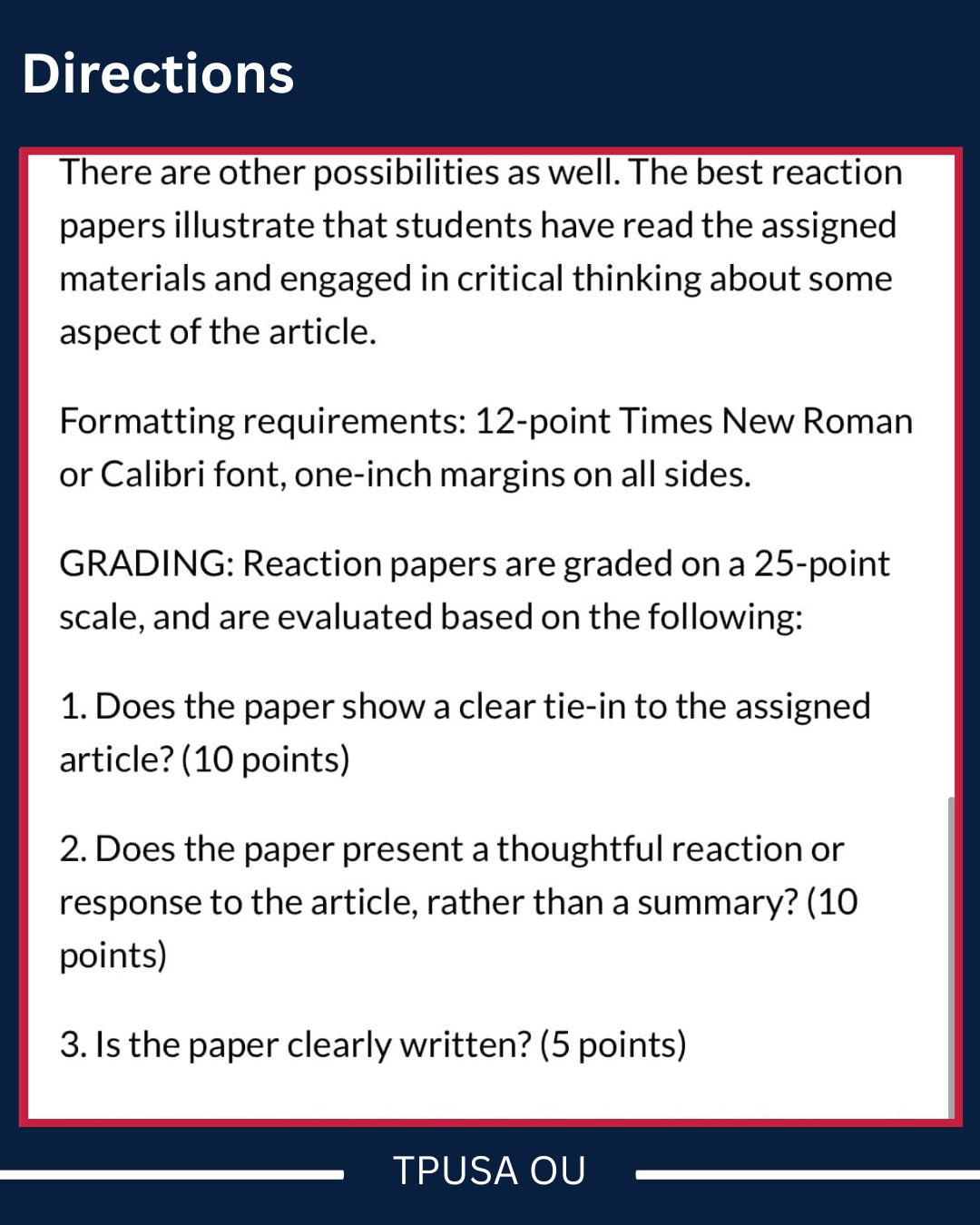
Assuming these are the instructions for the paper that were given we can pretty easily conclude that Fulnecky’s paper meets these standards. I have read it; I didn’t count the words. However, the claim that Fulnecky was failed because she “quoted the Bible” does not hold up because she does not quote the bible in her essay, she talks about what she thinks the Bible says.
This is not a composition or rhetoric course assignment but one in psychology and it is a pretty standard sort of assignment – read this and react to it. What’s missing though is consideration for our existence in an anti-rhetorical society. The instructor assumes that there is one kind of clarity, one kind of critical thinking, one kind of importance, etc. The assignment is provided in a vacuum. The instructor appears to have constructed this based on legalistic tricks prior students have performed such as the argument by sortie, an old French medieval argument method where acceptance of a large thing is based on acceptance of a smaller thing: “You’d accept an essay that was 640 words, so why not 620?” The assignment is based on frustration with technical issues, which as a professor myself I totally get. Students only want to focus on the technical requirements to get points: Turning things in on time (but if it was 5 minutes late you would accept it, so why not 20?), formatting it just on the line of appropriateness (font sizes, pica spacing, etc), and adding grammatical errors to AI generated texts (a novel one for me).
The assignment does not ask the student to read or think of it from the perspective of psychology, nor does it offer who they are addressing. Like all of our impoverished discourse in our current world, thinking is internal. Audience does not matter. This is your thinking and your opinion about this article as you, exactly how you are when you are reading it.
In psychology there is an old idea that I don’t know if it’s current anymore, but it really impacted my teaching. When I was younger I went with my family to see the great Robin William’s movie Dead Poets Society. Years later in college I found this idea in psychology and this old movie popped back into my mind. Keating, the teacher in the film, was engaged in a pedagogy of helping students see “possible selves,” an idea published around the same time as the film (1986) by Markus and Nurius in American Psychologist. The idea is that having a space and place to try out different “selves” is essential to the development of self and addressing the need to change one’s attitude, perspective, and stance in a society that is fundamentally chaotic under a thin veneer of organization (one of the master roles of rhetoric in human life). Fulnecky, living on a steady diet of “speak your truth” and not caring about how others feel about it took the prompt at face value and used it as an opportunity to communicate her shallow and malformed theology. And sure her beliefs are bad, but that’s not the point in a pro-rhetoric society. The point is that there is a way to express your views, and you should express your views, imagining that you are someone else hearing and seeing them. There’s immense value in an assignment that encourages students to react to a reading from a perspective instead of from their internal self-state.
Here’s how I would have offered it if I were in the position of this professor:
Read the assigned essay and prepare a reaction to it from the perspective of psychology. In this course, we have looked at how psychologists question, act, and speak. What do you think the psychological value is of this essay? What do you think is the most difficult aspect of this essay to communicate to others? And how would you, as a student of psychology explain this to others? Make sure you detail in your response who you think your audience is, what they assume, and what challenges you might face in communicating the value this piece has for psychology to those who might not have taken this course. (650 words, no more than 725 and no exceptions, 12 point double spaced with 1 inch margins).
The slight changes here indicate that rhetoric is vital to any evaluation of any research, argument, or writing from what Stephen Toulmin would call an “argument field.” There’s also the additional benefit here of giving the students carte blanche to select an audience of fundamental Christians or Mennonites or whoever they like and discuss some of the principles of psychological thinking and the professional nature of the field in the terms of this tough-to-reach audience. They also have the freedom to cite other readings from the course or mention moments in class discussion or lecture that stood out to them. The assignment the professor actually wants I would say is the one I wrote, not the one focused on litigious of word counts and amorphous (dare we say objective) assumptions about critical thinking and clarity.
Fulnecky didn’t write a high-quality paper maybe because she can’t but based on what I’ve read she wasn’t asked to. It would have improved her chances to directly quote the Bible and some theology maybe, but this wasn’t presented to her as a research exercise. It was an exercise in giving your opinion on something to read. In our society, I hate to say it, it’s considered totally legitimate to read a headline, or read the first line of something, roll our eyes, and toss it aside as liberal or fascist propaganda. This is expressing an opinion on an article!
Now for the other side: Samantha Fulnecky knows better. She’s been in college; she can read the code. This assignment clearly wants the student to express something other than their personal feelings – perhaps we could call it the “university rhetoric” where the student writes in platitudes (“There are many good ideas in this article, there are some I don’t agree with, and some I don’t understand fully”) and uses other commonplaces (“This reminds me of the discussion about chapter 5 we had earlier in the term”) that are the bread and butter of undergraduate writing. Why did she choose to go so hard on this reaction paper and in this way? Perhaps she was setting up the instructor for a political reason. I take her at her word that she believes that trans people should not exist, or are an aberration, or are unholy (it is unclear exactly what she means, so maybe she should miss some points for ‘clarity’ after all). She might have decided to bait the instructor into failing her so she could try to get the university to terminate someone who disgusts her. Who knows what her motives are. All we can do is construct the motives from what she’s done and continues to do in the controversy.
I think Fulnecky is smart enough to understand that it would be out of bounds in this assignment to write one’s strong religious opposition to trans-identities as a reaction to an article about the psychology of gender binaries on children (which I believe the article was about). She could have added her thought about Christianity or the Bible in there at some point and I think there would have been no controversy, as long as she hit 650 words, followed the margins, and discussed in specifics parts of the article. She should fail for not engaging the article directly and on the terms of what it said and she didn’t cite anything, including the Bible, in a way that communicates the practice of the discourse of a psychology student.
This feels like a set-up, similar to how the education professor at Texas A&M was pretty clearly set up by a student who started filming the class before she offered her ham-handed, awkward intervention there that got that professor fired. I believe it’s totally justified to fire professors and teachers who are teaching people what to think about something in an objective, universal framework. But this is exceedingly rare, and might be a straw person. What professors and teachers are doing is teaching how to speak, write, think, believe, and react within the confines of their field and their expertise. They are teaching students how to see a “possible self” as a member of that profession or discipline. This didn’t use to have to be communicated; we had more of a common public square of information and perspective that we all came from to be together in a classroom. But today everyone comes from one private place – the world of the podcast not the newspaper, the world of the video algorithm not network TV – and so this narrowness mistaken for a public set of commitments must be addressed by the professor in terms that indicate the depth of this division: Hey, in this class we are going to learn how experts and scholars in this field speak, think, and question. You have to imagine yourself as one of them. What’s the payoff? You’ll have insight into people who think like this for your future plans of convincing them that what you believe, think, and feel matters. And isn’t that the starting place of all good research intervention across the board?