
Oh No, Not Canvas!


The Canvas outage - about 14 hours long give or take - was frustrating and stressful for those involved in education. For me, it was the moment when the theater tricks broke, the lights came up, and the set and its workings were revealed in the work lights. Canvas is a learning management system which means it is managing what counts as learning.
Students showed extreme anxiety about handing things in on time. They showed panic about being able to see assignment requirements. In short, teaching via Canvas is about crafting “deliverables” in the required format, at the required time, to some kind of authority figure who will then “pay” you in points.
This theory of education I have called The Productive Bias for many years now, just haven’t ever written about it. The Productive Bias has the following elements:
On Time is as vital, if not more vital, than quality of assignment.
Elements such as spacing, font, page numbers, heading are vital if not more vital than the quality of the assignment.
The only metric that students are learning is production. That is, they need to produce something frequently to prove learning is happening, either their bodies in seats or 6 lines on a discussion board.
Class conversation and purpose is toward the clarification of production and reminding students that products need to be made by upcoming deadlines
All of this speaks to the deep fear and insecurity of professors about judging the actual content of what students write. The Fulnecky case that I wrote about a while ago is a good example of this kind of judgement, where the need to create and produce an assignment was the most important value in that classroom - the thoughtlessness of the approach of the assignment led to the entire controversy.
Canvas is comfortable, not good, not helpful. It’s comfortable because it models market capitalism transactions that we are all so used to they feel natural. Canvas teaches by its very structure: Get used to producing arbitrary deliverables at arbitrary times or you lose your job. It teaches students in classes where professors are anxious about whether they are teaching anything at all that the best way to approach the world is to disconnect and dissociate from the material - to become alienated from yourself.
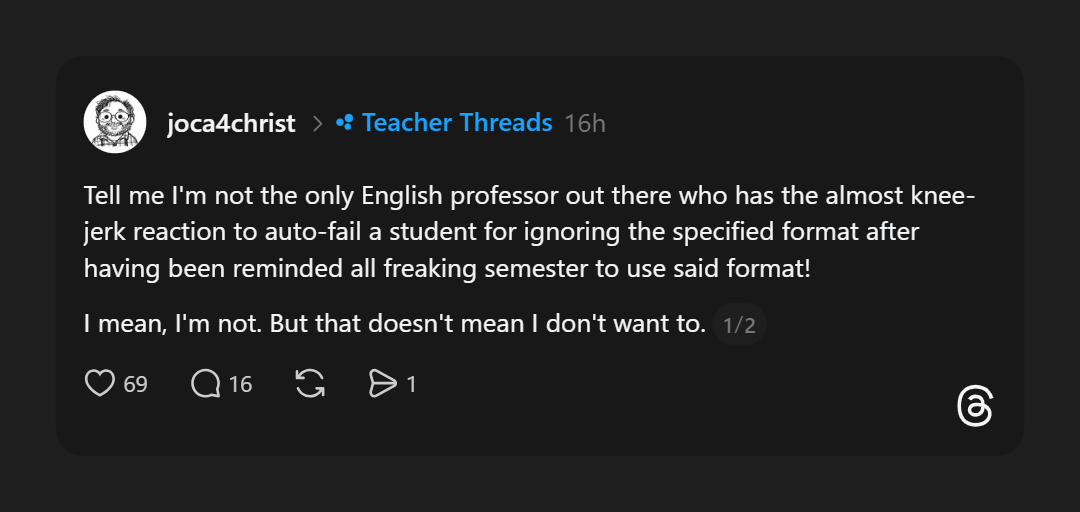
It would be great to return to a classroom that is a clear break from this labor market model or de-skilled labor market model where the only skill you need for a job is blind obedience to what the requirements are. I’ve already received the first of a few emails from failing students asking for “overtime” - what other assignments they could do to get an A. I have another student who continuously redoes an assignment because her grade is at a 94, not a 100. This is the kind of thinking that we are teaching in the productive bias, “pointsmaxing.”
The alternative is a slow class with few things to do. Reading together and talking about what we are reading, or having students lead with presenting some ideas about the class would be nice. Traditional lecture has a role to play against the productive bias, setting up an alternative but familiar world to podcasting and YouTube as consumer products. Lectures aren’t meant to sell anything might be the fundamental difference between them and the consumer product of a lecture, meant to be consumed.
Canvas isn’t alone in its formation of this attitude, professors are whenever they stand on principles that a corporation would value such as deadlines for deliverables above quality or format of a paper above engaging the arguments. They will respond “we are overworked,” to which I respond, assign less. When Canvas went down I wondered how I would access the grades in there, but as I went through it in my head I sort of knew where everyone was. I could have filled out the final grades from vibes alone. This is because there isn’t a lot of work in my class. We aren’t there to make anything, we are there to think and respond. Assessment, another corporate tool, has made many faculty doubt whether they are the expert in the room who can judge quality of student outcome, whatever form it might be. And grades can always be altered down the road if one needs time to read or think about a student outcome.
The model of higher education is bad enough without professors and instructors uncritically propping up free-market forms of action and reaction through how they manage their classrooms. Canvas is a part of that, but Canvas isn’t 100% to blame. We need an alternative mode of teaching from the Productive Bias. It will come when professors start with the assumption that the classroom is a different space - it’s not the “real world,” a trope many lecturers lean on time and time again. Time to make good on that claim. The classroom doesn’t have to be fully planned out, it can simply be a point of resistance through questioning this need to create and consume that seems to motivate everything around us.
Canvas could have a role here, it just needs to serve the class, instead of the class taking shape around it. Imagination not production should lead course design.
Any LMS is about the same, Moodle, Google Classroom, ... But a kind of "productive bias" was already there in teaching 5-paragraph essays: Students must turn in a nicely formatted essay printed from a computer, and it had been from the typewriter-era. I remember the days, in 1980, when I was last minute struggling with formatting my BA thesis with a typewriter when I was an English-major undergrad. Tools have been upgraded and the problem may have been worsened.